
Largest QR Code Ever: World Records and Size Guide
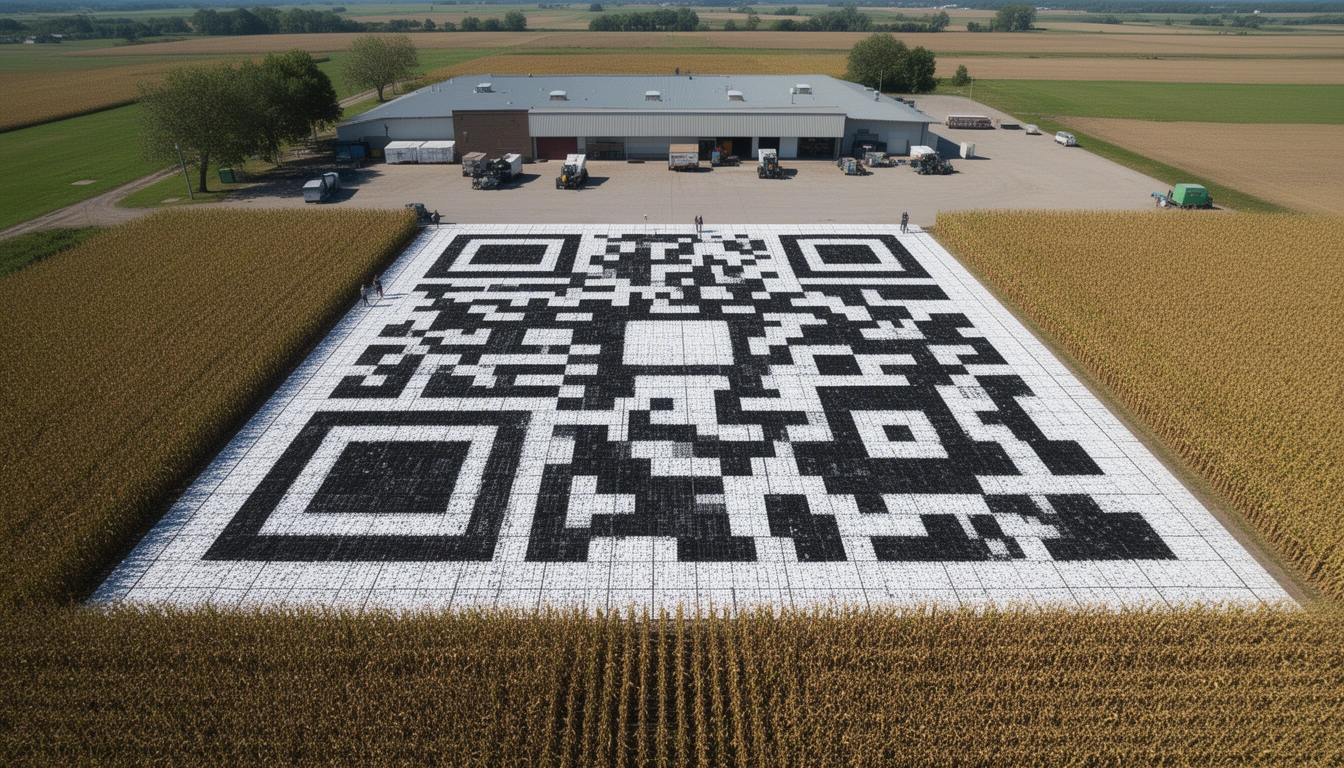
The largest QR code ever created covers 309,570 square feet, carved into a corn maze in Alberta, Canada. It's the record most guides still cite, and it was scannable from a plane flying overhead. It proved something useful: a QR code can grow to almost any size, as long as whoever is scanning it is far enough away to see the whole pattern at once.
Whether you're chasing a world record, planning a stunt, or just trying to figure out how big your QR code needs to be for a poster, storefront, or billboard, this guide covers the real numbers: the record holders, the size limits, and the dimensions that actually work in 2026.
What Is the Largest QR Code Ever Made?
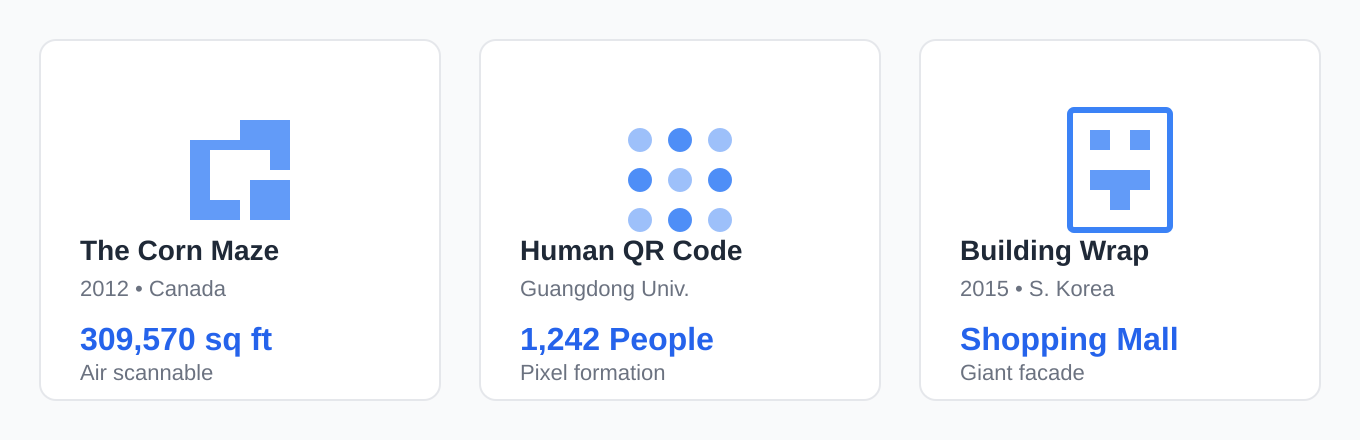
The three most documented giant QR codes are a 309,570 sq ft corn maze in Canada, a 1,242-person human formation in China, and a roughly 250,000 sq ft building wrap in South Korea. Each proves size is achievable; the real challenge is keeping the code scannable once it's that large.
The Corn Maze (2012)
The Kraay Family Farm in Canada carved a QR code into a corn maze. It spanned 309,570 square feet (about 28,000 square meters), was scannable from the air, and linked to the farm's website. It's still probably the most famous giant QR code ever made.
The Human QR Code
Students at Guangdong University in China arranged 1,242 people into a formation, with each person acting as a single pixel. It worked, assuming nobody sneezed or moved out of position.
The Building Wrap
In 2015, a South Korean shopping mall covered its exterior wall with a QR code roughly 250,000 square feet in size. Less creative than a corn maze, but permanent, and it demonstrated that a large QR code on a building facade can work if placed where there's real distance to scan from.
How Big Can a QR Code Be? (Maximum QR Code Size Explained)
There's no hard cap on how physically large a QR code can be, only a scanning-distance limit. Data capacity does max out, though: the largest QR code version (Version 40) uses a 177x177 module grid and can hold up to 7,089 numeric characters, 4,296 alphanumeric characters, or 2,953 bytes of binary data.
- Physical size: effectively unlimited. You can print or build a QR code any size, provided viewers can stand far enough back to see it whole.
- Data size: capped by the QR spec itself. More data means more modules, and more modules means the code needs to be printed larger to stay readable at any given distance.
- The rule of thumb: Scanning Distance = Code Width x 10. A 100-foot code needs about 1,000 feet of clearance to scan, which is why most giant codes rely on drones, aircraft, or hillside viewpoints.
Unlike different types of QR codes, which have fixed data limits by version, physical maximum size is really just a physics and sightline problem.
How Big Does a QR Code Need to Be?
A QR code needs to be at least 0.8 x 0.8 inches (2 x 2 cm) to scan reliably from arm's length with a phone camera. Beyond that, size has to scale with scanning distance, roughly one inch of code width for every ten inches between the scanner and the code.
| Scanning distance | Minimum recommended size |
|---|---|
| 4 to 6 inches (business card) | 0.8 to 1 inch |
| 1 to 2 feet (menu, flyer) | 1.5 to 2 inches |
| 3 to 5 feet (poster, counter display) | 2 to 3 inches |
| 15 to 30 feet (storefront window) | 3 to 5 feet |
| 100 to 200 feet (billboard) | 10 to 20 feet |
Below the 2 cm floor, most phone cameras can't focus on the individual modules, so anything smaller needs a specialized scanner rather than a consumer phone.
QR Code Dimensions and Sizes by Use Case
The right QR code dimensions depend entirely on where it's placed and how close people will be when they scan it. Here's how common use cases stack up.
| Use case | Recommended size | Typical scan distance |
|---|---|---|
| Business card | 0.8 to 1 inch | 4 to 6 inches |
| Flyer or menu | 1.5 to 2 inches | 1 to 2 feet |
| Poster | 2 to 3 inches | 3 to 5 feet |
| Storefront window | 3 to 5 feet | 15 to 30 feet |
| Trade show backwall | 6 to 10 feet | 20 to 40 feet |
| Vehicle wrap | 3 to 4 feet | 20 to 30 feet |
| Billboard | 10 to 20 feet | 100 to 200 feet |
| Building facade | 100+ feet | 1,000+ feet |
Why Do Long URLs Make a QR Code Bigger?
A "long" QR code is usually the result of a long URL. More characters mean more data, and more data forces the generator to add more modules to the grid, which makes the pattern denser and harder to scan from a distance, even if the printed size stays the same.
Shortening the destination link before generating the code keeps the module count low, so the QR code stays scannable whether it's printed on a business card or blown up to storefront size. This is one of the easiest fixes for a code that looks "too busy" up close. A free QR code generator with tracking that shortens the link first will produce a cleaner, lower-density code than pasting a long tracking URL straight in.
Why Make a Giant QR Code? (Practical Use Cases)
Most giant QR codes are marketing stunts, but there are practical reasons to go big beyond the world-record chase.
- Aerial visibility: festivals and airports use them because a captive audience is already looking down from a plane or a hill, making it a cheap way to get a scan.
- Rooftop advertising: drones can scan rooftop codes, turning dead roof space into a billboard.
- Event stunts: arranging cars or people into a code makes for a good photo op and drives traffic to an event app or site, especially when the code is paired with a QR code deep link for offline marketing that skips the app store entirely.
- Art: artists use giant codes to comment on connectivity or surveillance. It's niche, but it happens.
How to Build Your Own Large QR Code
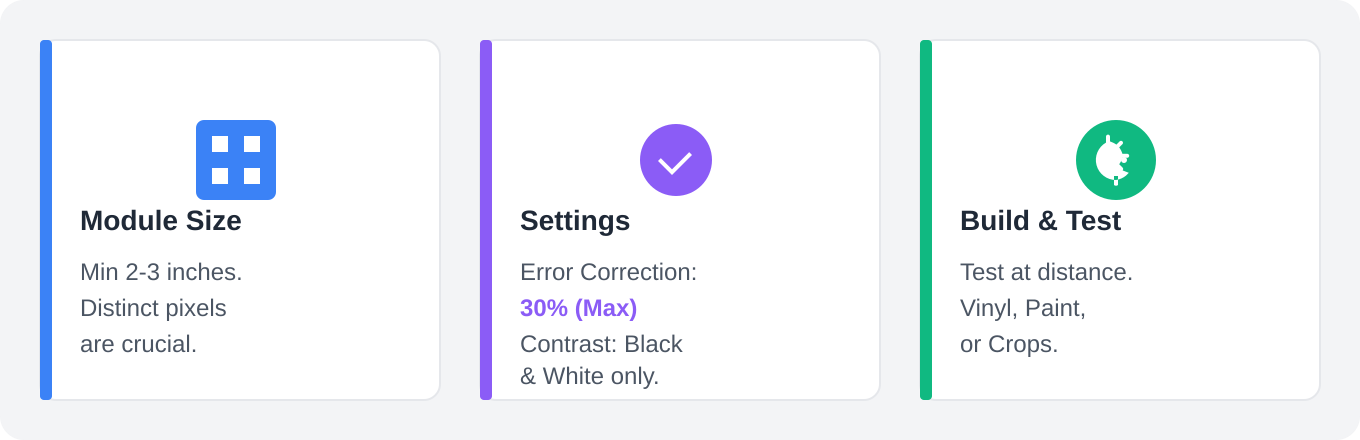
If you're actually planning one, the design rules change once size gets involved.
Design
- Module size: each pixel needs to be distinct. Don't go smaller than 2 to 3 inches per module for large outdoor codes.
- Error correction: max it out at 30%. You'll need the buffer for installation errors or weather.
- Contrast: stick to black and white. You can play with QR code colors on small codes, but at scale, high contrast is a safety margin, not a style choice.
- Testing: test it from the intended viewing distance before you finalize the install, using different phones.
Materials
- Vinyl: cheap, works for temporary installs.
- Paint: good for walls, but permanent.
- Crops or plants: the eco option. Seasonal, obviously.
- LED screens: expensive, but you can change the code daily.
Tracking
Don't guess if a giant code worked. Use a QR code generator with tracking, or compare options in this QR code generator comparison before you commit to a build.
- Check total scans.
- See when people scanned it (flight paths, rush hour, event start times).
- Track device types and locations, covered in more depth in this guide to tracking QR codes.
Smler's analytics dashboard handles this whether it's a corn maze or a business card.
Why Giant QR Codes Fail
Going big introduces problems you don't have with a flyer.
The Distance Problem
A 50-foot code needs 500 feet of clearance to scan. In a city, that sightline might not exist.
Focus Issues
Phone cameras aren't optimized for distance shots. They may hunt for focus or resolve the code poorly.
Precision
A 1% alignment error on a 10-foot code is over an inch of drift. That's enough to break the scan.
Maintenance
Birds, weather, and dirt ruin contrast over time. A faded code is a dead code.
Legal Stuff
- Permits: large structures need approval before install.
- Aviation: codes near airports might confuse pilots. The FAA may have opinions.
- IP: using a code in public art? Make sure you own the content it links to.
Large QR Code Optimization Checklist

- Shorten the URL. Fewer characters mean fewer modules and a cleaner scan at any size.
- Tell them what it is. "Scan for 20% off" outperforms a naked code every time.
- Build a mobile-first landing page. Don't send a scan to a desktop-only site.
- Track it. Use Smler's analytics to see whether the size and placement actually paid off.
These same rules apply to everyday "large" codes that don't need a world record, just clear scanning distance. A 3 to 5 foot code on a storefront window, a 6 to 10 foot backwall at a trade show, or a 4 foot panel on a delivery van all work well when paired with Smler's branded links, since people trust a readable URL more than a cryptic short link.
What's Next for Giant QR Codes in 2026
- AR triggers: scanning a building-sized code launches an AR experience, turning the code into a portal.
- Drone delivery IDs: rooftop codes could identify specific buildings for delivery drones.
- Dynamic LEDs: change the code hourly on a big screen and run A/B tests without printing anything new.
Frequently Asked Questions
What is the largest QR code ever made?
The largest documented QR code is a 309,570 square foot design carved into a corn maze at the Kraay Family Farm in Canada in 2012. It was scannable from the air and remains the record most sources cite, ahead of a South Korean building wrap and a human-formation code in China.
How big can a QR code be?
Physically, a QR code has no true size limit as long as scanners can get far enough away to see the whole pattern, roughly ten times the code's width. Data capacity is capped by the QR spec itself: Version 40 is the largest, storing up to 7,089 numeric characters.
What is the maximum QR code size?
There are two answers depending on what "size" means. Physically, there's no fixed maximum, only a scanning-distance limit. In terms of data, the maximum is Version 40, a 177x177 module grid holding up to 2,953 bytes of binary data or 7,089 numeric digits.
How big does a QR code need to be?
At minimum, a QR code needs to be about 0.8 x 0.8 inches (2 x 2 cm) to scan from arm's length with a phone camera. Beyond that, size scales with distance, add roughly one inch of width for every ten inches between the scanner and the code.
How big should a QR code be for printing?
For most printed materials, 1 to 2 inches works for flyers and menus, 2 to 3 inches for posters, and 3 to 5 feet for storefront windows viewed from across the street. Match the size to the expected scanning distance rather than picking one size for everything.
What is a long QR code?
A long QR code usually refers to a dense, high-module code created from a long URL or a large amount of embedded data. Shortening the destination link before generating the code reduces the module count, making the pattern simpler and easier to scan at any print size.
Start Your QR Code Campaign Today
You probably aren't building a 300,000 square foot maze. But the same size rules that govern the world's largest QR codes apply just as much to a window display, a trade show backwall, or a billboard.
Try Smler's free QR code generator if you want built-in analytics and custom branding. It handles the tracking, shortening, and routing. You handle the design.
From world records to store windows, QR codes bridge physical and digital. The size is just the hook, the content behind it is what keeps people around.
Published with LeafPad