
How many QR codes can actually exist?
If you use QR codes for campaigns, you might have a nagging worry: will I run out? Will I accidentally print a duplicate? The short answer is no. The long answer involves numbers that don't make sense to the human brain.
The math is stupid big
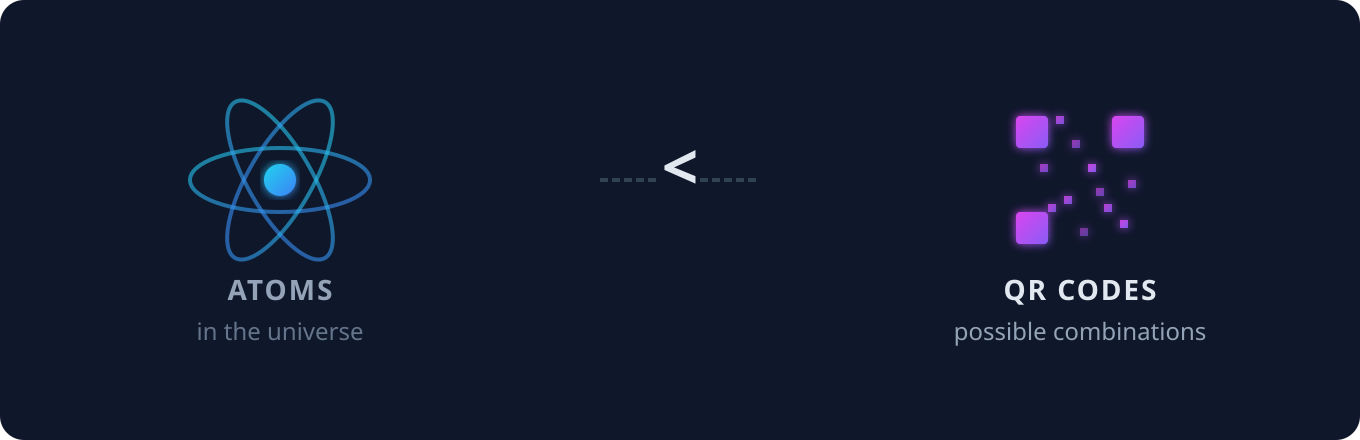
There are more possible QR codes than atoms in the observable universe. I mean that literally. You could assign a unique QR code to every atom in existence and still have leftovers.
Here is how it works.
Versions and modules
QR codes come in 40 versions. Version 1 is a 21x21 grid. Version 40 is a 177x177 grid. Each square is black or white. That is binary.
For a Version 1 code, the math is 2^441. That is roughly 9.1 × 10^132 combinations.
The observable universe has about 10^80 atoms. A Version 1 QR code the smallest one has more variations than that.
For a Version 40 code, the calculation is 2^31,329. This number has roughly 9,000 digits. It is too large for a standard calculator to even show you.
The fine print
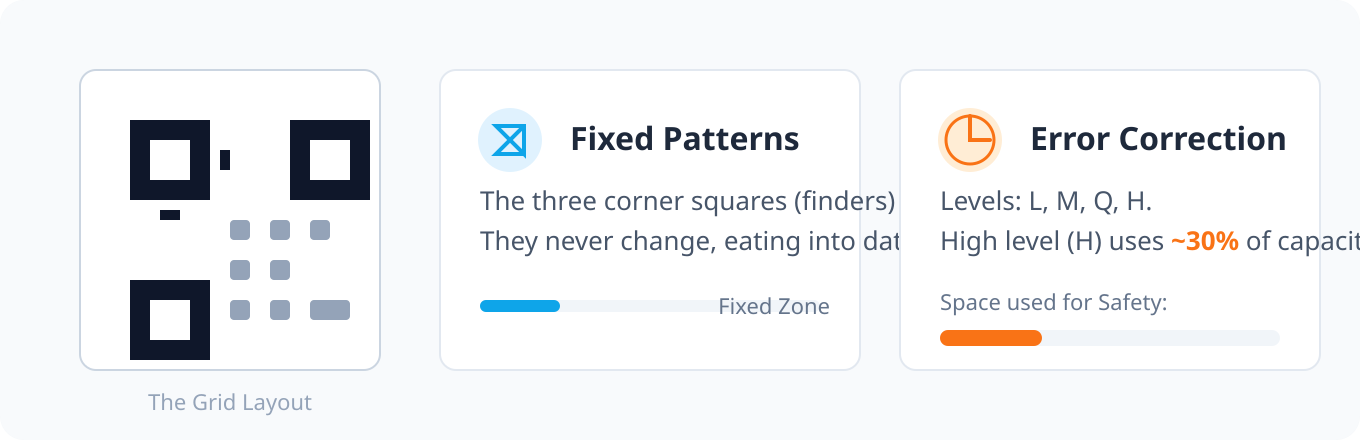
The numbers above assume every square is available for data. They aren't.
Error correction eats space. QR codes have four levels (L, M, Q, H). High correction uses about 30% of the data just to fix scanning errors. This reduces the space for your URL, but the total combinations stay high.
Fixed patterns take up space too. The three squares in the corners? They never change. Even after subtracting them, you have an ocean of possibilities.
Does this matter for your campaigns?
If you use a QR code generator with tracking like Smler, the bottleneck is not the technology.
You will not run out. If every human generated a million codes a second for a trillion years, we would barely scratch the surface. The odds of accidentally printing the same code as another company are effectively zero.
So stop worrying about capacity. Worry about the stuff that breaks campaigns:
- QR code colors that look nice but don't scan.
- Picking the wrong error correction level.
- Missing out on QR code use cases that fit your audience.
A quick comparison
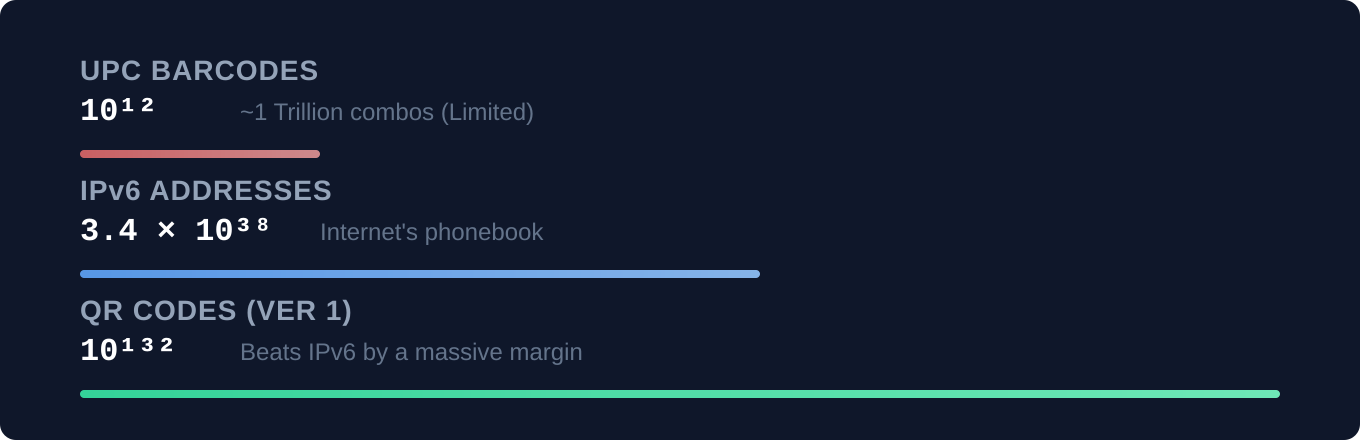
UPC barcodes manage about 1 trillion combinations. That is limited enough that you need central management. IPv6 addresses (the internet's phone book) allow 3.4 × 10^38 addresses. QR Codes (Version 1)? 10^132 combinations.
QR codes beat the internet's addressing system by a massive margin.
Why infinite codes matter
When you aren't limited by ID space, you can do things differently.
Manufacturers can put a unique code on every single product unit, not just every SKU. This allows for specific tracking and anti-counterfeiting. Event organizers can generate codes for billions of tickets without duplicates.
Marketers can use link-level analytics to track specific touchpoints. Put a different code on a flyer, a billboard, and a business card. Know exactly where the scans came from.
How Smler handles it
Our QR code generator creates a unique code for every shortened URL. We handle the uniqueness so you don't have to.
We offer custom branding and bulk generation for large campaigns. You can even update the destination URL later (dynamic QR codes) without reprinting anything.
If you are looking at different types of QR codes, capacity will never be the bottleneck.
The takeaway
We will never run out of QR codes. The limit isn't the technology it is how you use it. Focus on the strategy. The codes will be there.
Ready to start? Check out Smler's QR code solutions.
Published with LeafPad